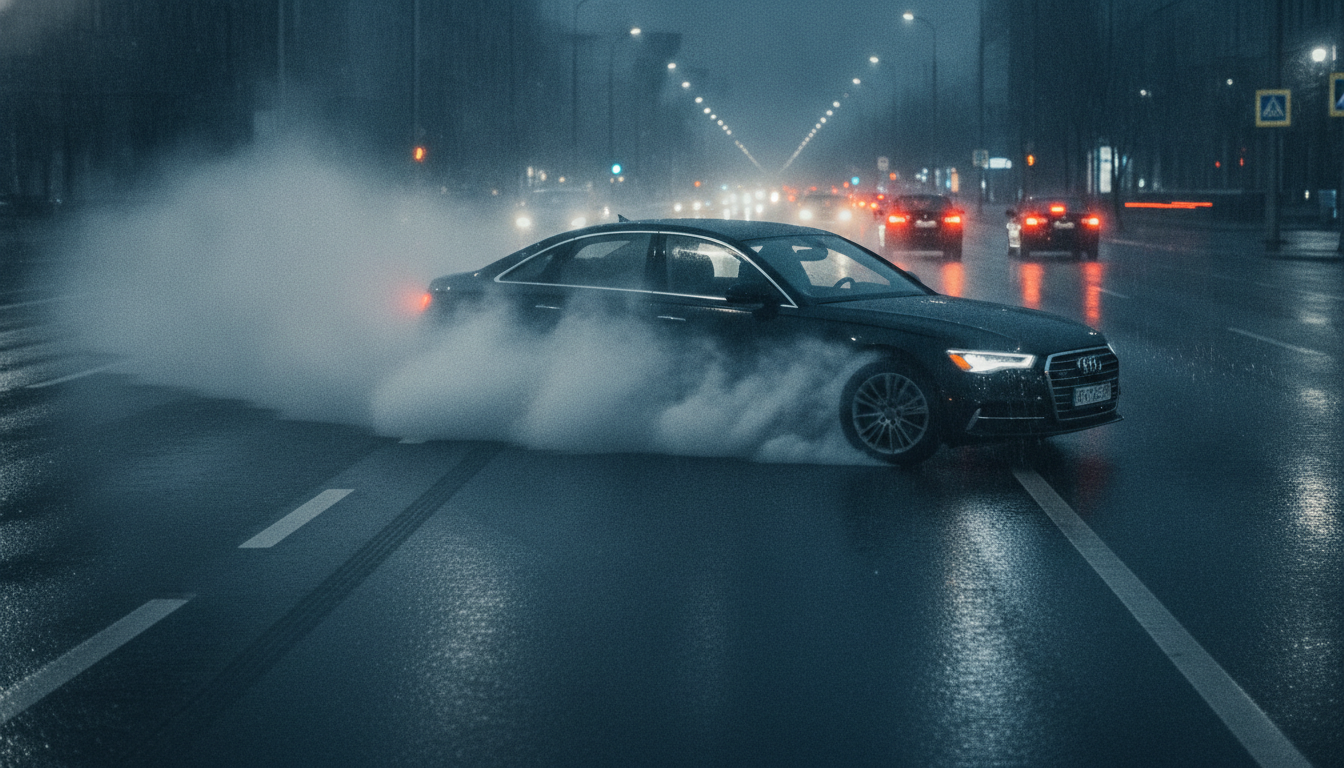
Ask a well-trained driver about electronic stability control, the ESC built into every modern car, and many will tell you the same thing. It gets in the way. It is a nanny. It is for people who cannot really drive. Give them a good vehicle and the first thing they reach for is the button that turns it off, so they can feel the machine without a computer correcting them. That instinct feels like mastery. The one moment that instinct is ever tested, it is what could kill the person in the back seat.
The belief that “under pressure, a trained driver's hands beat the system” is a claim you can test. To know if it is true, you have to understand what the system actually does, because the driver is trying to do exactly the same thing.
It all happens at the tires. A tire has only so much grip to give. Think of that grip as a budget the driver spends. He can put all of it into one job, braking, or split it between two, braking and turning. What he cannot do is spend more than he has. 80% on the brakes leaves 20% for the turn, and no more. Ask the tire for more than 100%, and the grip breaks, and the car goes.
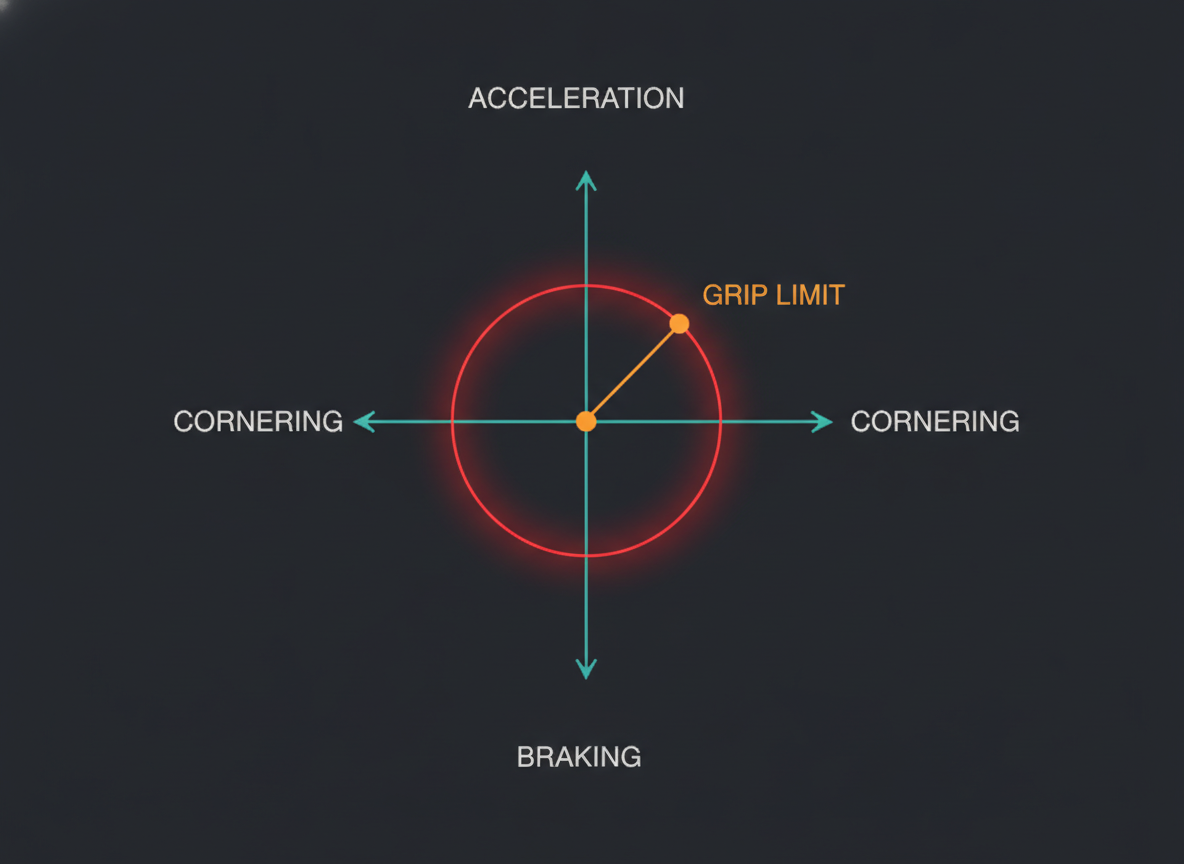
A good driver's job is to keep all four tires just under that limit, at all times. That is also what ESC is designed to do, several times a second. So the fight was never electronics against instinct. It is one question: who spends the budget better when things get complicated, the man or the machine?
Threshold braking is the best example. It is a technique used by professional drivers: braking at the exact limit, a hair short of locking, with no ABS, the tire's whole budget poured into stopping, which is, without question, the most efficient way to brake there is, if you get it right. The problem comes the moment the car also has to turn. Now the driver has to give some grip back to the front tires, easing off the brake by exactly the right amount to give them the budget they need to steer. How much budget? That is the problem: it depends on whether the priority is to turn or to brake. Add stress or fear, and the chance of hitting that balance is almost zero. ABS, on the other hand, does all of this automatically, stress or no stress, and always gives priority to the turn.
Here is why the machine wins, and it has nothing to do with talent.
The brain has two ways to run a task like that. One is slow and deliberate. It thinks, judges, and corrects in small steps, one at a time, and it lives mostly in the prefrontal cortex, behind your forehead. The other is fast and automatic. It runs in the amygdala and the brain stem, the reflexes you do not have to think about. Metering the brake against the steering needs the slow, deliberate one. And the moment a real threat hits, that is the one the brain takes away. The stress chemistry that prepares you for a crisis quiets the prefrontal cortex and hands control to the automatic system. Amy Arnsten's research at Yale mapped exactly this: under sharp stress the thinking brain goes quiet and reflex takes over. It is not a flaw. It is what saves you when the answer is to act now, with no time to think.
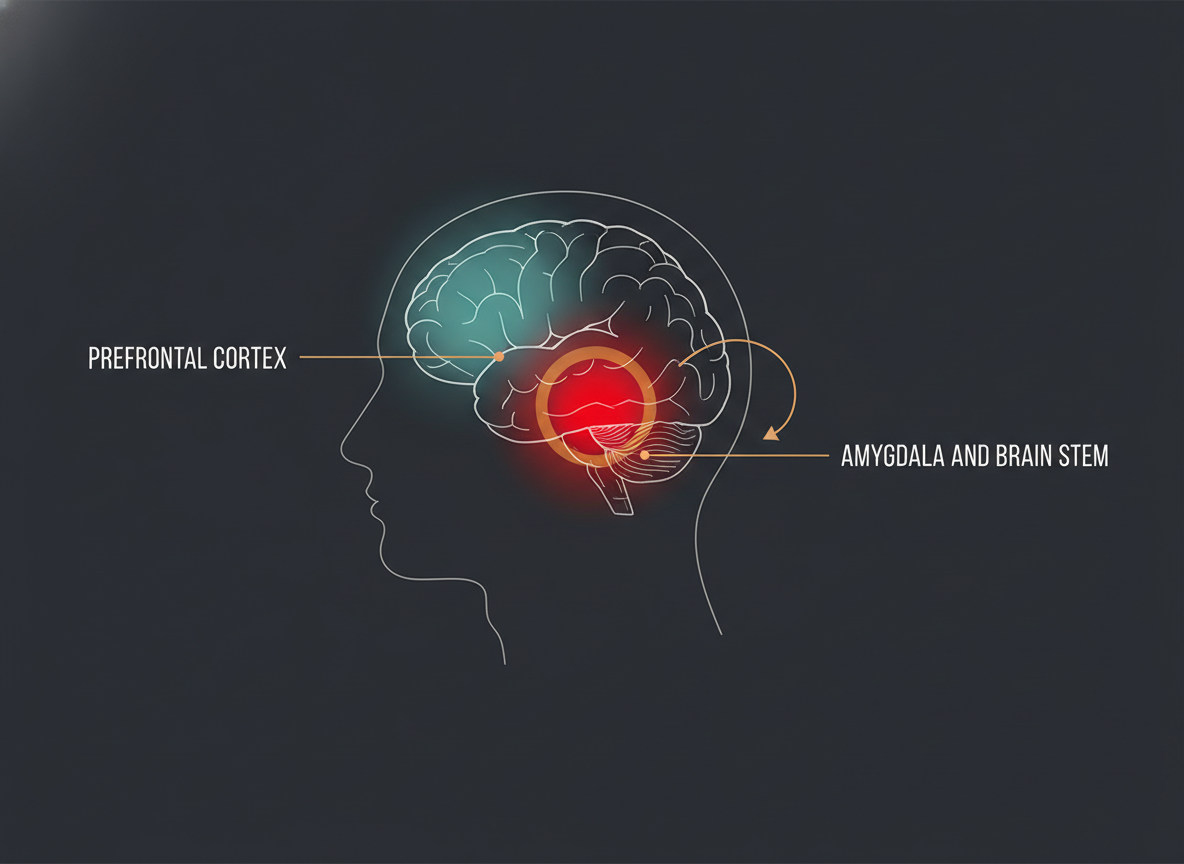
But reflex has only one setting, and it is loud. It cannot hold 80% against 20%. It goes all or nothing. So the driver does not lose the grip budget because his skill failed. He loses it because the deliberate part of his brain just handed the wheel to a part that knows only full and empty. The brake hits the floor and the wheels lock, and a locked wheel has no steering. Or the foot never finds the pressure, and the car carries on with grip to spare. Either way it ends up where the driver did not want it.
Could this skill be built? A professional race driver could probably get there after the prodigal ten thousand hours of training and stress inoculation. Even so, we see F1 drivers, the most elite in the world, lock their wheels in the corners where the stress outruns the skill. But a working driver does not have that kind of time to train. If he is lucky, he manages fifty hours a year. So there is no chance of building a skill strong enough to beat ABS, let alone ESC.
The tests have been done, over and over. NHTSA designed a program to teach drivers to brake at full force, and after training them briefly, added a surprise barricade to the exercise. Only one in four managed to brake hard enough to stop the vehicle, even though the braking capacity was there.
If we already know that human beings have limited cognitive capacity, why do we pile on an absurd load, even when it might be more efficient than the electronic system under normal conditions? What beats the skilled driver is his own nervous system.
This is what ABS and ESC are for. They take that responsibility off the driver's brain and hand it to a system that, though it might be a little less efficient under normal conditions, always works the same way and never overloads under stress. ABS does its job while the driver does the easy part: stand on the pedal with everything he has and steer. ESC goes further. When the car starts to spin or run wide, it brakes a single wheel on its own or reduces engine power to correct the line. No driver can do that. The system can control each tire independently, braking and sending power exactly where it is needed most. He cannot.
So the driver who turns the system off to drive on his own hands has it backwards. He thinks he is taking control. He is giving it away. If we only have a few hours a year to train, the skill worth developing is not chasing the limit of grip. It is learning to work with the systems, making strategic decisions and letting the system hold the grip, and using what attention is left on what no machine can do: finding the threat, the gap, and the way out.
ESC was never the enemy. The enemy is the belief that under stress the hands will hold what the brain has already let go.
Sources
Amy F. T. Arnsten, “Stress signalling pathways that impair prefrontal cortex structure and function,” Nature Reviews Neuroscience 10 (2009): 410-422.
NHTSA, Human Performance Evaluation of Light Vehicle Brake Assist Systems, Report DOT HS 811 251.