
Security Driver
Certification
Every training school hands you something at the end. Most of it does not mean what the word on the paper implies. Here is the difference between a certificate and a certification, and what to ask for instead.
Why No One Can Certify a Security Driver
A certificate from a serious school means something real. It documents that a person showed up, did the work, and finished a structured program. Hiring managers are right to value it.
A certification is a different instrument. It requires a third party, a standard-setting organization, and a defensible, industry-wide definition of what the professional must demonstrate. Medicine has this. Aviation has this. So does security management itself.
What a Real One Looks Like: The CPP
The security industry already knows how to certify. The Certified Protection Professional (CPP®) from ASIS International is the board certification for security management, and it passes every test a certification must pass. A candidate needs years of verified professional experience before they may sit for the exam, and the exam is built from an industry-wide job task analysis of what security managers actually do. Passing confers a title, the way a college degree does: letters after a name that a third party stands behind.
The roles behind that title are deliberately separate, and the separation is the whole point. The American National Standards Institute (ANSI) holds the standard: through its accreditation arm, the CPP program is accredited under ISO/IEC 17024, the international standard for bodies that certify persons. Holding the standard means one thing above all: every candidate, everywhere, is measured against the same values. The teaching can be done by any third party. ASIS carries out the assessment, compares each result to what the standard mandates, and certifies the candidates who clear the threshold. Teacher, examiner, and standard-holder are three different parties. No one grades their own homework.
The title is not permanent, either. The holder must meet yearly upkeep requirements to keep it. Let them lapse, and the certification is lost and the exam must be taken again.
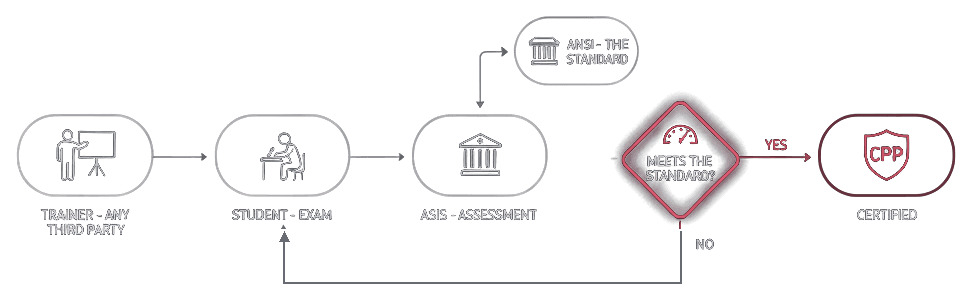
Security driving has none of this structure. No organization has performed a job task analysis defining what a security driver must demonstrate, no accredited body holds a standard for the discipline, and no independent party administers an assessment separate from the training itself. Because that chain has never been built, a security driver certification cannot currently exist in the strict sense of the word. Programs that advertise one are in practice offering a certificate of completion, or an assessment measured against criteria from an unrelated field.
The distinction matters in practice. To a security manager, the word certification signals that an independent third party verified a driver's competence against an established standard. In security driving that verification is not possible today, because the standard it would depend on does not exist.
What AS3 does insteadCPP is a registered trademark of ASIS International. ASIS and ANSI appear here as an example of a properly governed certification; AS3 Driver Training is not affiliated with either organization.
Certificate vs Certification
The two words are used interchangeably in marketing. They are not interchangeable in meaning.
| Certificate | Certification |
|---|---|
| Results from an educational process. | Results from an assessment process. |
| Open to newcomers and experienced professionals alike. | Typically requires professional experience to attempt. |
| Awarded by the training provider or institution itself. | Awarded by a third-party, standard-setting organization. |
| Indicates completion of a course with a specific focus. | Indicates mastery measured against a defensible set of standards, usually by application or exam. |
| Course content is set by the provider: instructor, faculty, or dean. | Standards are set through a defensible, industry-wide process of job analysis and role delineation. |
| The end result. It demonstrates knowledge at a point in time. | Carries ongoing requirements. The holder must keep demonstrating they meet the standard to retain it. |
What AS3 Does Instead
If the industry cannot certify, what can it do? It can measure. Consider how aviation answers the same question. Since Edward Link built the first flight simulator, pilots have been tested in the machine, under load, against outcomes an instrument can record. The question is never whether the pilot attended ground school. It is whether their hands did the right thing when it counted.
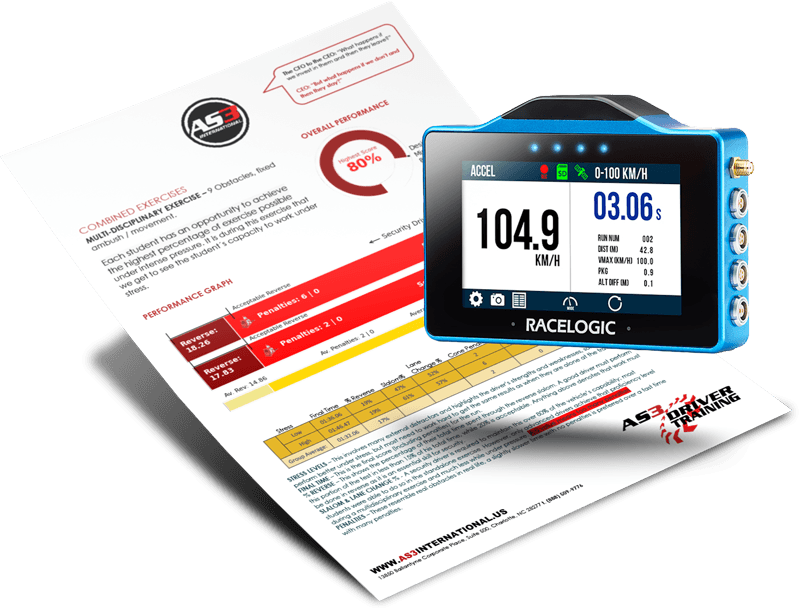
AS3 applies the same answer to driving. Racelogic telemetry records every exercise, accurate to 0.1 seconds and 0.1 mph: speed, braking force, lateral acceleration, line. Each driver is rated against the international standard of controlling at least 80% of the vehicle's capability, and against their peers on the same exercises.
Course completion produces a certificate and an individual performance report, available online. The certificate says the driver was trained. The report shows what the driver can do. Only one of those can be verified by a third party, because only one of them is data.
Common Questions
Is there a nationally recognized security driver certification?
No. No third-party, standard-setting body currently defines what a security driver must demonstrate, so no organization can award a security driver certification in the strict sense of the word. The contrast with security management is instructive: the CPP from ASIS International is accredited by ANSI under ISO/IEC 17024. Nothing comparable exists for security driving, so programs that advertise a certification are either using the word loosely or borrowing a standard from an unrelated subject.
What does AS3 issue after a course?
Two documents. A certificate of completion, and an individual performance report generated from Racelogic telemetry recorded during every exercise. The report is available online after the course and shows, exercise by exercise, how much of the vehicle's capability the driver actually used.
What is the 80% standard?
The international standard for security drivers requires demonstrated control of at least 80% of a vehicle's capability. According to the Society of Automotive Engineers, most drivers use only about 40%. The gap between those two numbers is where incidents are lost or survived, and it is what AS3 measures.
How long is a certificate good for?
The certificate documents a point in time. The skills behind it decay: research on high-stress skill retention shows the steepest decline in the first weeks after training and significant degradation by 6 to 12 months without practice. This is exactly why real certifications carry ongoing requirements, and why we recommend periodic refresher training such as the Accelerated Level II program.
What should a security manager ask a training provider?
Three questions. What did you measure? Against what standard? Can you show me the data for each of my drivers? A provider who measures performance can answer all three with documents. A provider who certifies attendance cannot.
Training That Measures
Every AS3 program is measured by onboard telemetry and produces an individual performance report. Security drivers start with the Advanced [Counter-Ambush] Driving Course, the Level I entry point.
The next resume that crosses your desk will say certified. The word costs nothing to print.
What evidence sits behind it?