
Can you realistically expect to achieve mastery in your trade? Most people answer that question with a number of years, which is the wrong unit entirely. Here are five things you need to understand before you answer it.
1. How a skill gets built
You isolate the movements the skill requires, and through guided repetition your brain builds new connections between the neurons needed to perform them. Those connections are called synapses. When the new circuit can reproduce the action, the skill exists.
That is the whole of it. Not talent, not aptitude, not what you were like as a kid. A physical structure that repetition assembled.
2. Insulation is what makes it fast
Once the skill exists, deliberate practice changes how efficiently it runs. The brain wraps the active circuit in myelin, an insulating material that makes the signal faster and more reliable, which is the difference between dial-up and broadband running through the same wire.
McKenzie's team proved the wrapping is not decoration. They blocked the production of myelin-forming cells in adult mice in 2014, and the animals could no longer learn a motor task their untreated littermates picked up in a week. Bengtsson had found the human side of it in 2005, where pianists showed measurable differences in exactly the regions their practice loaded.
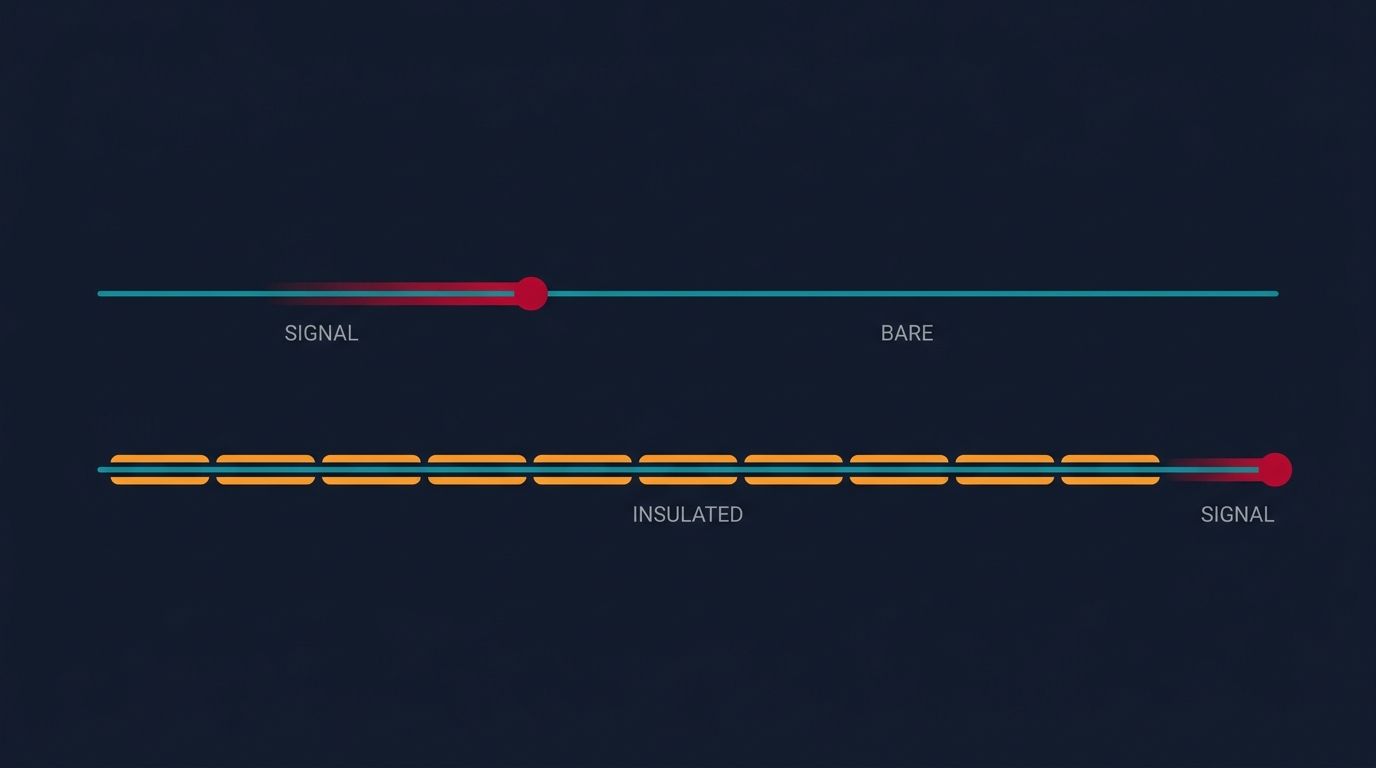
So, the skill is built by time, and the speed of the skill is built by more time. Hold onto that, because everything that follows is about what happens to time you already spent.
3. What ten thousand hours actually measures
Ten thousand hours is not a switch. It shows the scale of the investment.
Gladwell's rule has been criticized heavily for oversimplifying mastery, and the criticism is fair, because Ericsson never proposed a threshold. He studied violinists and reported that the best group had accumulated roughly that much practice by their twenties. It was an average describing a population, not a line you cross.
But the central point survives. Professional athletes invest that time and more into a narrow set of skills because mastery requires an enormous time budget, and nobody has found a way around it. Talent does not exist without the work.
4. What happens when you stop performing it
How far it goes
The U.S. Army Research Institute has been measuring skill retention for fifty years, across tasks that soldiers were trained to perform correctly and then simply did not perform for a while.
Sabol and Wisher tested soldiers recalled to service after more than a year away and found losses of up to 83% on hands-on tasks. The largest analysis of skill retention ever assembled, funded by ARI and published in 2025, pulled 1,344 measurements out of 457 studies and put half of everything training built as gone at roughly six months. Procedural tasks show measurable degradation inside the first month.
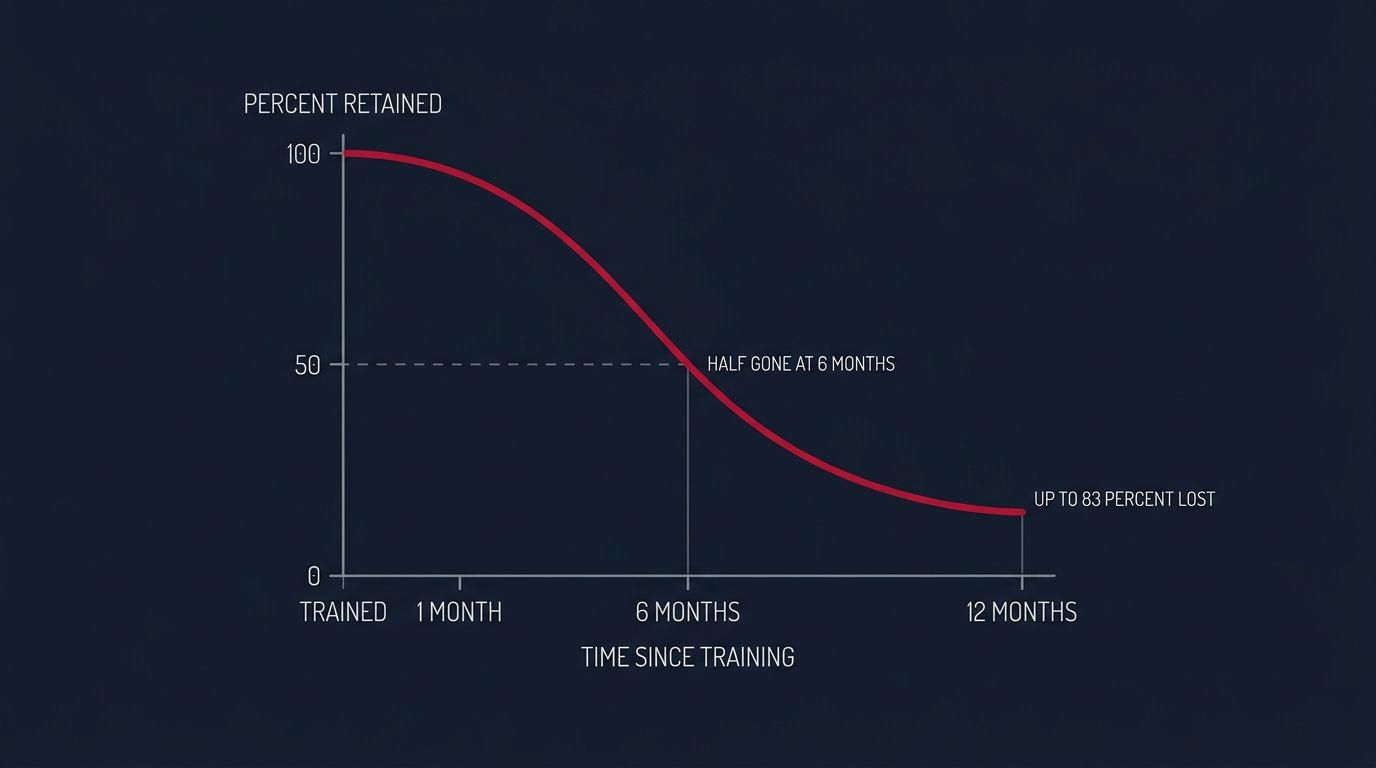
Nobody in those studies was injured. Nobody was tested on something they had never learned. They were trained to standard, they walked away, and the standard walked away with them.
What you lose is not what you remember
ARI reviewed three decades of its own retention research in 1999, published by Wisher, Sabol and Ellis, and the finding separates two things most people treat as one.
Memory for task knowledge holds well. Memory for cognitive skill holds well. Physical execution is the one that varies, and it varies most on tasks assembled from separate ordered steps. The conscious memory of the skill can remain while the ability to perform it disappears.
Read that again.
You will remember the sequence. You will remember why each step exists and what happens when you get it wrong. You will walk a colleague through the whole thing over coffee, correctly, in order, while your hands are somewhere else entirely.
Why you will not feel it happen
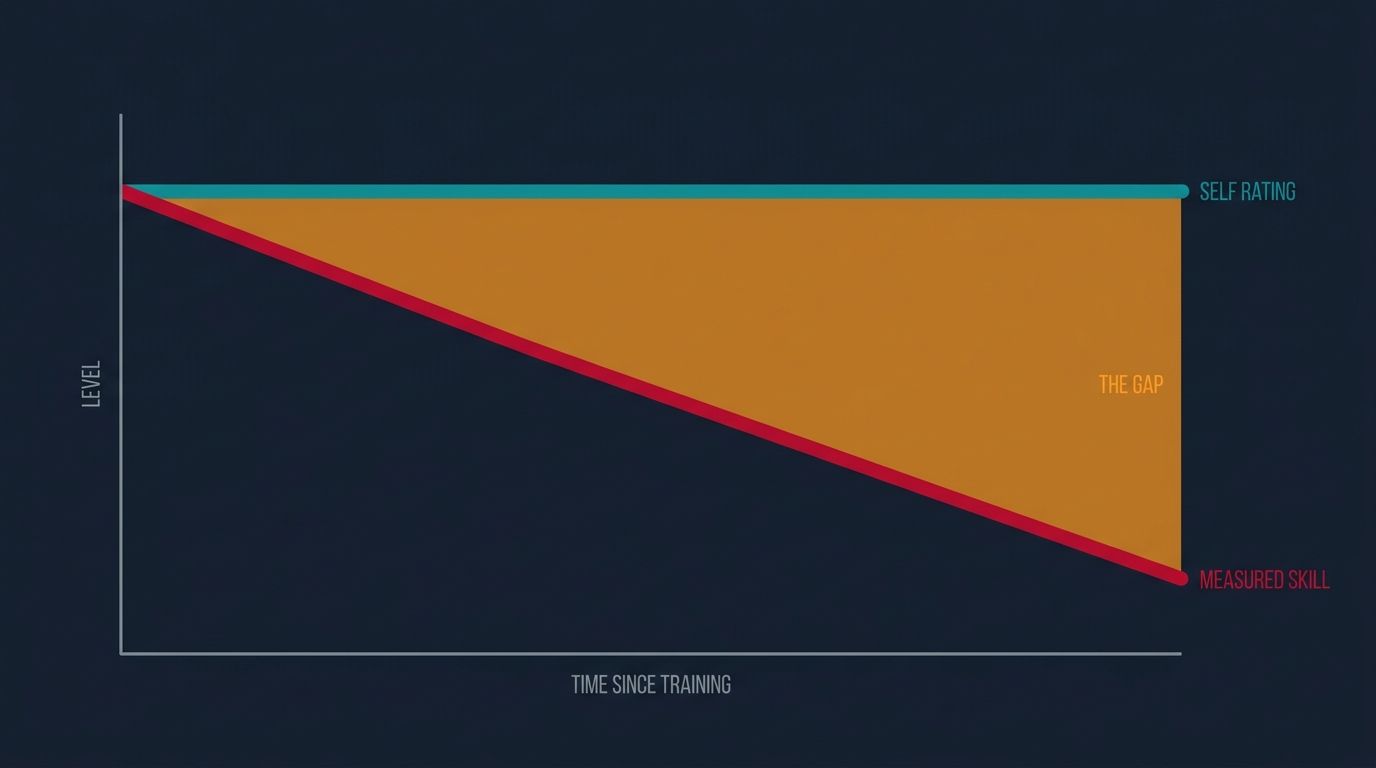
Hollister and his colleagues tested private and commercial pilots in 1973 against measured flight performance. The longer it had been since certification, the worse they flew. The pilots' own assessment of their skill predicted nothing about how they actually performed.
Killian had already found the same thing in 1965, surveying United Air Lines second officers. No self-reported decline, from anyone, at any experience level.
Measured skill fell. Self-rating held flat. That is the gauge you are operating on, and it reads full the entire way down.
5. The return trip is shorter than the trip out
The structure is still in there. What decayed was access to it and precision in running it, which is why coming back is consistently cheaper than getting there was. Gardlin and Sitterley reviewed the retraining literature in 1972 and found that people returned to their previous standard in well under half the repetitions it originally took, and the more thoroughly they learned it the first time, the faster they came back.
That changes the arithmetic completely. If two days built the capability and you return within six months, you are not spending two days rebuilding. You spend part of it restoring what slipped and the rest going past where you were, which makes every return a repair and an increase at the same time. Stay away for two years and you are closer to paying full price again with nothing to show for the interval.
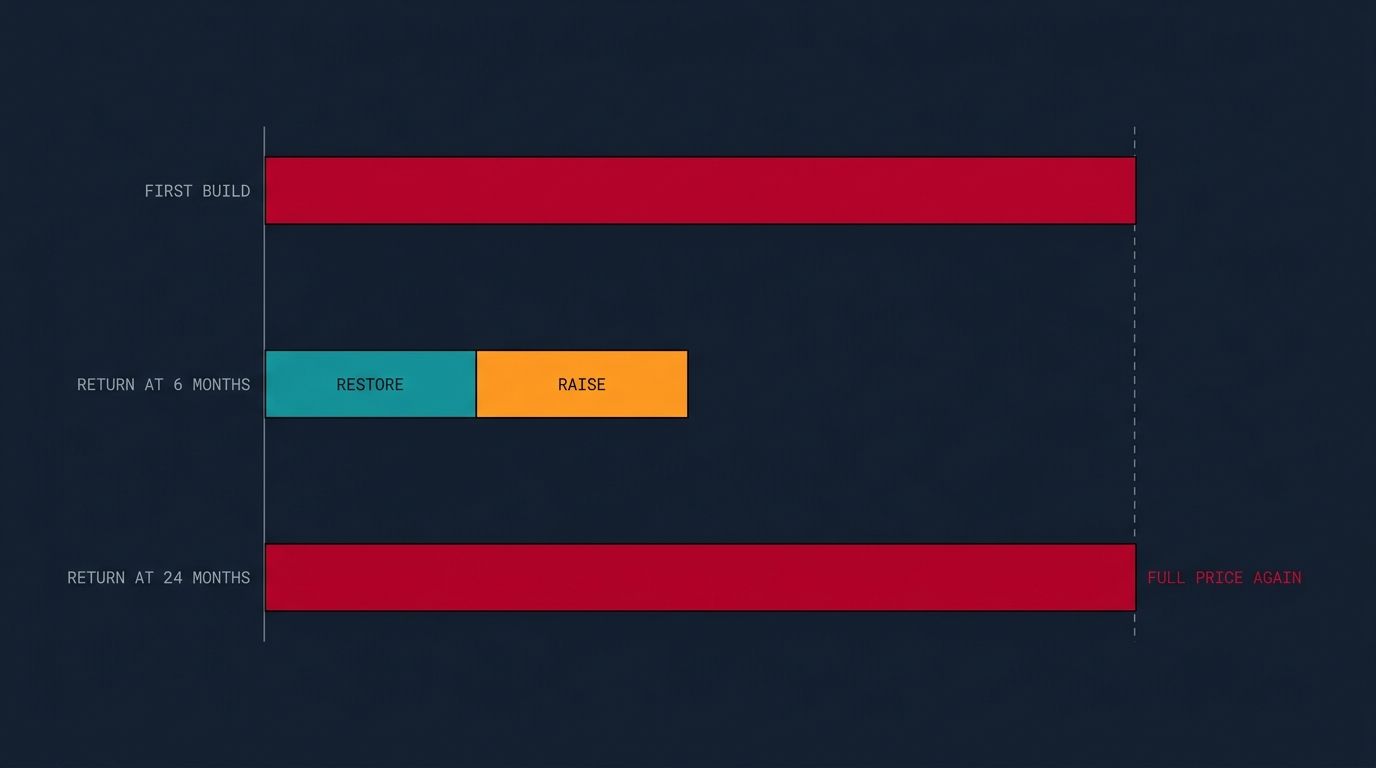
Restore the base. Use the remaining time to raise it.
Mastery is a scheduling problem
The skills that need returning are the ones assembled from separate ordered steps, executed rarely, with nothing telling you when you executed them badly. Your team drives every day, so basic vehicle control is not your exposure. The three-step emergency procedure nobody has run since the last course is.
Find those skills. Build the schedule around their decay rate. Protect the hours the way you protect any other operating cost.
Mastery is not a state you reach. It is a standard you hold, and holding it is a scheduling decision.
The Army schedules refresher training against measured decay rates rather than the calendar, and for some tasks that interval is six months. No private operation runs that cadence. Annual is the working standard, and annual holds, because the return costs less than the original build and the surplus goes into raising the standard instead of restoring it.
Past twelve months the arithmetic inverts. You stop maintaining the skill and start buying it again at full price, which is what Sabol and Wisher measured when their soldiers came back after a year away having lost up to 83% of their hands-on performance.
Sources
Sabol, M. A. and Wisher, R. A. (2001). Retention and Reacquisition of Military Skills. Military Psychology, 13(4).
Wisher, R. A., Sabol, M. A. and Ellis, J. A. (1999). Staying Sharp: Retention of Military Knowledge and Skills. U.S. Army Research Institute, Special Report 39.
Rose, A. M. et al. (1985). Acquisition and Retention of Soldiering Skills. U.S. Army Research Institute, Technical Report 671.
Schendel, J. D., Shields, J. L. and Katz, M. S. (1978). Retention of Motor Skills: Review. U.S. Army Research Institute, Technical Paper 313.
Tatel, C. E. and Ackerman, P. L. (2025). Procedural skill retention and decay: A meta-analytic review. Psychological Bulletin, 151(6).
Sitterley, T. E. and Berge, W. A. (1972). Degradation of Learned Skills. NASA CR-128612.
Gardlin, G. R. and Sitterley, T. E. (1972). Degradation of Learned Skills: A Review and Annotated Bibliography. NASA-CR-128611.
Hollister, W. M. et al. (1973). Identifying and Determining Skill Degradation of Private and Commercial Pilots. FAA-RD-73-91.
Killian, D. C. (1965). Pilot Proficiency Retention for United Air Lines Second Officers.
McKenzie, I. A. et al. (2014). Motor skill learning requires active central myelination. Science, 346(6207).
Bengtsson, S. L. et al. (2005). Extensive piano practicing has regionally specific effects on white matter development. Nature Neuroscience, 8.
Ericsson, K. A., Krampe, R. T. and Tesch-Römer, C. (1993). The role of deliberate practice in the acquisition of expert performance. Psychological Review, 100(3).